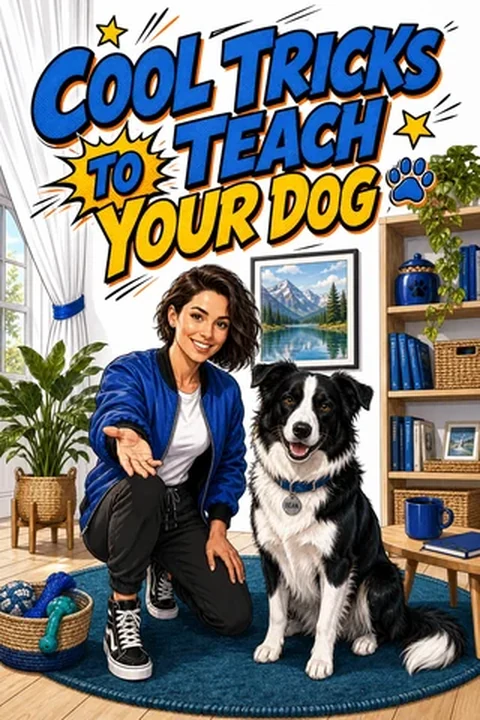
Teach your dog 30 amazing tricks they'll love to show off.
No expensive trainers. No confusing methods. Every trick is drawn out comic-book style, so you can see exactly what to do instead of reading a wall of text about it.
1Say the cue, once2Show the treat3Paw comes up4Reward. Done.
Comic panels, not a wall of text
Why this book is different
Every dog loves learning when it's fun. Most training books forget the fun part, so they end up too complicated, too dry, or written for professional trainers. This one is drawn instead. Every trick plays out in panels you can follow with your dog right in front of you, which is why kids can run a session from it too.
You see the step, you don't decode it
Each panel shows one movement. No guessing what “lure into position” means.
Praise and treats, never pressure
Reward-based from the first page. Nobody, dog or human, gets told off.
30 tricks, so you never run out
Start at “Sit, Bean!” and finish on a three-cue routine. There's always a next one.
Right now you're probably wondering whether your dog can even learn this stuff. Give it a fortnight and the question changes to “what should we teach next?”
Not a taster. This is everything in the book, in the order you'd teach it. Work down the list and your dog goes from “sit” to a three-cue routine you can perform for guests.
Beginner · 1 to 10
The foundations
Fast wins that teach your dog how learning works. Most people get through these in the first fortnight.
01Sit, Bean!
02Down Time
03Touch!
04The Name Game
05Spin in a Circle
06Shake Hands
07High Five and Wave
08Take a Bow
09Ring the Bell
10Find It!
Intermediate · 11 to 20
Thinking games
Scent work, searching and body awareness. This is the tier that tires a dog out without a single walk.
11Which Hand?
12Cup Detective
13Muffin-Tin Mystery
14Box Search
15Find Your Toy
16Find Your Person
17Around the Marker
18Back Up
19Peekaboo
20Head Down
Advanced · 21 to 30
Chains and showpieces
Low-impact, joint-friendly, and the ones people film. Each builds on tricks your dog already knows.
It reads like a comic, which is the whole point. You prop it on the counter, glance at the panel, and get on with the session instead of losing your place in a paragraph.
01
Comic-style lessons
Every trick drawn out in panels. See the hand position instead of reading a description of it.
02
Small, simple steps
No trick jumps. Each one starts from something your dog can already do.
03
Positive reward training
Praise and treats throughout. Nothing that relies on correction or frustration.
04
Tips that actually work
What to do when your dog stalls, loses focus, or nails it once then forgets.
05
Three difficulty tiers
Beginner, intermediate, advanced. The challenges keep coming as your dog gets sharper.
Ten minutes of trick work asks more of a dog's brain than an hour of sniffing the same lamp post. Owners usually start for the high five and stay for everything else.
1
It tires them out properly
Mental work drains a dog faster than a walk. Useful on rainy days and after surgery.
2
Nervous dogs get braver
Every trick your dog nails is proof that trying things works out well. That carries over.
3
They start watching you
Focus you build over treats at home is focus you get back on a busy street.
Some dogs pick up a trick in one session. Others need a week of the same five minutes. Both are normal, and because it's drawn rather than written, the kids can run a session as well as you can.
First dogKids who want to helpPuppies with no off switchOlder dogs, new tricks
A group class costs hundreds. This costs nine dollars.
Six weeks of group training runs into the hundreds, and you still go home with homework. This is 30 tricks for the price of a squeaky toy, except this one doesn't get destroyed by Thursday.
One payment, lifetime access. Yours to keep, no subscription.
Before you buy
The questions people actually ask
I've never trained a dog. Is this over my head?
No, you're exactly who it's drawn for. Trick one is “Sit, Bean!” and it assumes you know nothing. Because the steps are panels rather than paragraphs, there's very little to misread.
My dog is eight. Is it too late?
Not at all. Older dogs often concentrate better than puppies do. The whole advanced tier is deliberately low-impact, so if their joints are stiff you can skip the floor work and still have plenty left, scent games, toy naming, the cue-card trick.
Do I need a clicker or any kit?
No. Small treats, a few minutes a day, and somewhere your dog feels comfortable. A handful of the search games use a muffin tin or some paper cups, which you already own.
How do I actually get it?
A download link comes through immediately after checkout. If it hasn't appeared within a couple of minutes, check your spam folder before you email anyone.
Is 30 tricks too many to get through?
You're not meant to. Most people work the beginner ten, live there a while, then dip into the rest when they fancy a challenge. The list is there so you never hit a wall.
How long until my dog can do one?
Depends on the dog and the trick. High five often lands in a few sessions. Tidy Toys can take a few weeks. Neither one means anything is wrong.
What if my dog hates it?
Stop and try again another day. Nine times out of ten it's the timing or the treat, not the dog. If you're seeing real fear, pain or aggression, that's a conversation for your vet or a qualified reward-based trainer, not a trick book.
Your dog already loves spending time with you. Every trick you teach turns that time into something you'll both remember. Grab some treats, open panel one, give it five minutes.